Free extract from The Complete Supplement Guide
The Overhyped Ten
10 compounds · graded against the clinical literature · free
Ten supplements the industry sells hard, and what the research actually shows. Every one of them earned the same grade in my 147-entry guide: Overhyped — the marketing claims substantially exceed what the evidence supports.
The whole report is on this page. Nothing is held back, and there is nothing to sign up for.
Download the PDF version →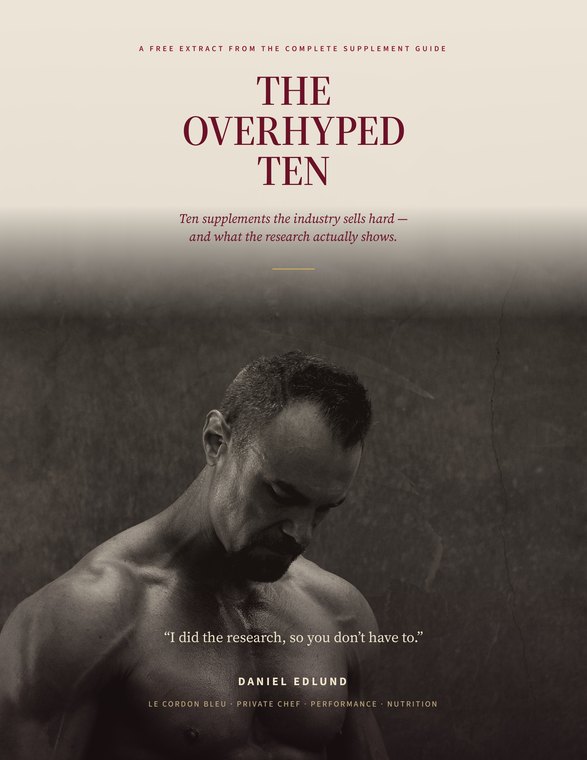
Why this exists
Almost anyone will tell you what to take. Far fewer will tell you what to skip.
That second list is the more useful one. It is shorter, it saves you money immediately, and it is the part that takes actual work to produce.
I spent thirty years in strength training and nutrition, fifteen of them cooking professionally for people who want nutrition cooked properly, and the last several reading the clinical literature for a 147-entry reference guide. Grading each compound honestly meant creating a rating I did not enjoy assigning: Overhyped. Ten compounds earned it.
I am giving these away rather than keeping them behind the paid guide for a simple reason. If you are going to trust my assessment that something does work, you should first watch me tell you plainly about ten things that do not. A rating scale that never returns a negative result is not a rating scale, it is a catalogue.
What I would rather you take away is not the list. It is the pattern. These ten fail in five recognizable ways, and once you can see the five, you can evaluate the next compound the industry pushes at you without needing me at all.
Failure mode one
No human evidence at all
The compound is a bestseller. The human clinical trial record is empty. In both of these cases the product reached the market through a broadcast rather than through research.
Raspberry Ketones
Sold as fat burning, metabolism enhancement, adiponectin elevation
There are no published, peer-reviewed, adequately powered human clinical trials showing fat loss from raspberry ketone supplementation at doses you can actually buy. A 2013 systematic review found no credible human trial data. The proposed mechanism comes from animal and in-vitro studies; reproducing those animal doses in a human would require quantities orders of magnitude larger than any commercial product contains, and would cost hundreds of dollars a day. It entered mainstream consciousness in 2012 through a popular television physician, not through scientific discovery.
If you wanted that effect: green tea extract, capsaicin, glucomannan or berberine — all with real human evidence for the same goal.
Worth knowing: most commercial raspberry ketone is synthetic. Genuine extraction would take roughly 41 kg of fresh raspberries per 100 mg dose.
Fadogia Agrestis
Sold as testosterone boosting and libido enhancement
As of this writing there are no published, peer-reviewed human randomized controlled trials. A 2024 consensus review confirmed the evidence base is limited to small animal experiments and isolated case reports. Every testosterone claim traces back to rat studies from a single Nigerian research group — and those same studies showed dose-dependent testicular, liver and kidney toxicity at higher doses, including inflammation and reduced sperm counts. The human-equivalent dose at which that toxicity appeared is uncomfortably close to the doses sold commercially. Its popularity came almost entirely from one podcast recommendation.
If you wanted that effect: Tongkat Ali — nine published RCTs, a meaningful human safety record, and the same marketing position.
Worth knowing: Momentous, one of the more reputable supplement companies, discontinued their fadogia product specifically citing insufficient safety data.
Failure mode two
The mechanism is real. It does not survive human trials.
Something genuinely happens in a petri dish or a rat. It stops happening in a well-designed study of actual people. This is the most common failure mode in the whole industry, and the most persuasive, because the mechanism sounds so convincing.
Tribulus Terrestris
Sold as testosterone elevation, athletic performance, libido
Sold as a testosterone booster since the 1970s. It has never raised testosterone in healthy men. A 2025 systematic review searching 13 databases found testosterone increases were statistically nonsignificant across clinical trials in men. A 2023 meta-analysis found nonsignificant increases in both testosterone and LH in humans, despite significant effects in animal models. The proposed mechanism — steroidal saponins, chiefly protodioscin, stimulating luteinizing hormone — works in rats. The better-designed the trial, the less likely it was to show benefit.
If you wanted that effect: zinc, vitamin D3, boron and ashwagandha have meaningfully stronger evidence for testosterone. If libido is the actual goal, Tongkat Ali has a more credible mechanism.
Worth knowing: adulteration with undisclosed anabolic compounds and pharmaceutical testosterone precursors has been documented in tribulus products.
Forskolin
Sold as fat loss and testosterone elevation via cAMP activation
Forskolin genuinely activates adenylate cyclase, raising cAMP, which stimulates hormone-sensitive lipase and releases stored fat. On paper this is one of the most compelling mechanisms in the category. The most widely cited fat loss study followed 30 overweight men for 12 weeks; the forskolin group trended toward reduced body fat, but the primary outcomes did not reach statistical significance for fat mass loss. A second commonly cited trial in overweight women found no significant change in body composition versus placebo. The testosterone finding has never been replicated in any rigorous follow-up.
If you wanted that effect: caffeine reaches cAMP-mediated lipolysis by a different route, and capsaicin has better human data.
CLA (Conjugated Linoleic Acid)
Sold as fat loss, lean mass preservation, body composition
One of the most extensively studied fat loss supplements in existence, and one of the most consistently disappointing. Animal studies, particularly in mice, showed dramatic fat loss. Human studies showed modest, inconsistent and clinically questionable results. A 2024 review in Nutrients described CLA effects on obesity as inconsistent due to dose-dependent outcomes and individual variability, and noted that its dual nature — both beneficial and adverse effects — raises questions about long-term safety.
Worth knowing: the isomer problem, which is essentially never explained on a label. The t10,c12 isomer drives most of the metabolic effect and also drives insulin resistance and raised CRP. Commercial CLA from safflower or sunflower oil delivers both isomers in roughly equal proportion, and you have no way to separate them.
Failure mode three
It never reaches your bloodstream
The compound does what the label says — in a test tube. Taken orally at the dose in the bottle, it is destroyed or diluted long before it arrives anywhere it could act.
Chrysin
Sold as aromatase inhibition, blocking testosterone converting to estrogen
In vitro, chrysin is a genuine aromatase inhibitor. That part of the marketing is not a lie. A human pharmacokinetic study found plasma chrysin levels undetectable or negligible after oral doses of 400 mg and above, because it is metabolized almost entirely by intestinal and hepatic enzymes before reaching systemic circulation. A 2001 double-blind trial in healthy men found chrysin produced no significant change in testosterone, estrogens or luteinizing hormone versus placebo.
If you wanted that effect: DIM and cruciferous vegetables offer more credible estrogen metabolism modulation through better-characterized, human-relevant mechanisms.
Pine Pollen
Sold as testosterone and androgen support
Pine pollen really does contain testosterone, DHEA and androstenedione, which is what makes the marketing superficially credible. The premise is technically true. The arithmetic makes it irrelevant. The concentration of testosterone in pine pollen is approximately 80 nanograms per gram, so a 1,000 mg dose delivers roughly 80 nanograms in total — around 75,000 times less than the roughly 6,000 micrograms a healthy man produces in a day. Oral androgens then face substantial first-pass hepatic metabolism on top of that.
Worth knowing: pine pollen is a significant airborne allergen. Anyone with pollen allergies should approach these products with appropriate caution.
Failure mode four
The evidence belongs to the seller
Positive trials exist. They were funded, run and published by parties with a direct financial interest in the outcome, and nobody independent has reproduced them.
Irvingia Gabonensis (African Mango)
Sold as weight loss, appetite suppression, blood glucose and cholesterol
The two most-cited trials — one reporting an average of 12 to 13 kg lost over 10 weeks — were both conducted by the same Cameroon-based research group, both used the patented IGOB131 extract, and both were funded largely by the patent holder. Neither has been independently replicated in a well-controlled setting by researchers without financial ties to the product. A 2013 systematic review concluded the evidence was insufficient to recommend African mango for weight loss. The reported magnitude of weight loss is implausible relative to any known dietary supplement effect, which is itself a reason for scepticism.
If you wanted that effect: berberine, glucomannan or green tea extract, all of which have independent replication.
Garcinia Cambogia / HCA
Sold as appetite suppression and inhibition of fat synthesis
The 2011 Journal of Obesity meta-analysis that marketers cite did find statistically significant weight loss versus placebo, but the difference was small, short-term and clinically questionable in practical terms. Critically, the authors noted that the more rigorously designed trials showed smaller effects. That inverse relationship between trial quality and effect size is one of the clearest markers of a compound that looks more promising in weak research than it actually is.
Worth knowing: a liver injury signal appears across multiple case reports. Causality is not definitively established, but given how weak the efficacy evidence is, the risk-benefit calculation is particularly unfavorable. Avoid combining with statins or with serotonergic medications.
Failure mode five
It is biochemically impossible
Not weak evidence. Not mixed evidence. The claim requires a reaction the human body cannot perform.
Wild Yam / Diosgenin
Sold as a natural source of progesterone or DHEA, particularly to women
Wild yam root contains diosgenin, a steroidal saponin that can be converted into progesterone and other steroids — through a multi-step chemical synthesis, in a laboratory. The human body does not possess the enzymes required to perform that conversion. There is no equivalent process in human physiology. A product marketed as natural progesterone or DHEA from wild yam is selling a biochemical impossibility. A double-blind crossover trial found wild yam cream produced no change in serum progesterone, DHEA, androstenedione or testosterone compared with placebo.
The confusion is historical: diosgenin was genuinely used as a starting material in the pharmaceutical synthesis of progesterone in the 1940s. That is a factory process, not a physiological one.
If you wanted that effect: anyone who genuinely needs progesterone or DHEA support requires medical evaluation and, where indicated, pharmaceutical-grade bioidentical hormone therapy under physician supervision.
The part that outlives the list
How to spot the next one
Seven questions. They cost nothing, they take about a minute, and between them they would have caught every compound on this page.
If this was useful
The ten compounds on this page are the ones that failed. Applying the same standard to everything else is the guide: 147 entries across nine categories, each graded Strong, Moderate, Emerging or Overhyped against the actual clinical literature — with dosing, optimal form, bioavailability, purity red flags, what to stack it with, what to avoid it with, and the food-first alternative where one exists.
Read the full guide →Instant download. Thirty-day refund, no questions asked.
Medical disclaimer. Daniel Edlund is not a licensed physician, registered dietitian, or licensed healthcare provider, and is not authorized to practice medicine or to diagnose, treat, cure or prevent any disease or medical condition. This page is provided for general educational and informational purposes only and does not constitute medical advice or a substitute for consultation with a qualified healthcare professional. Individual results vary. If you have an existing health condition, are pregnant or nursing, or are taking prescription medication, consult your physician before making changes to your diet or supplement routine. Statements regarding dietary supplements have not been evaluated by the Food and Drug Administration. Compound assessments reflect the peer-reviewed literature available at the time of writing and may change as new research is published.