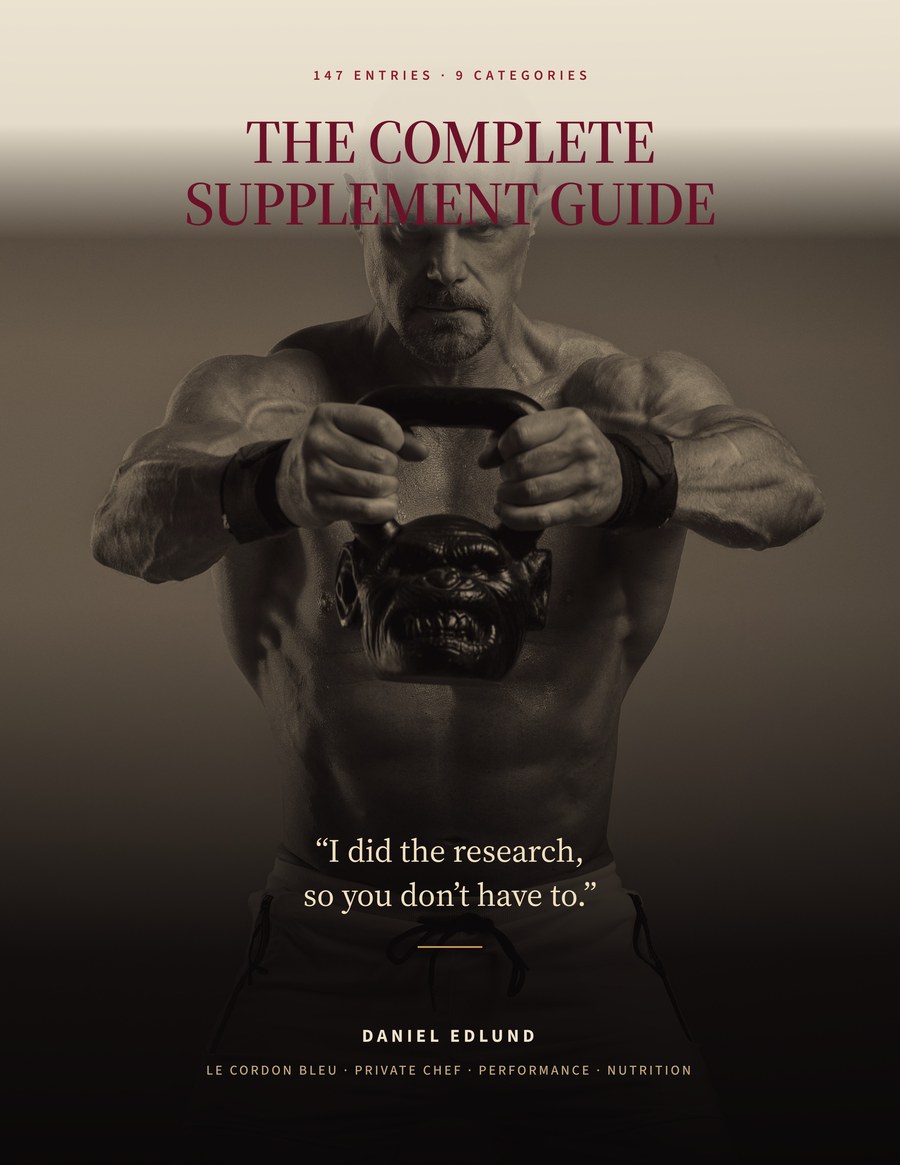
Free entry from The Complete Supplement Guide
Creatine
Graded Strong · Performance & Strength · free to read
Creatine is the most studied performance supplement in existence, with over 30 years of consistent evidence behind it.
The form that actually absorbs, the purity red flags and what not to stack it with are in the guide.
Get The Complete Supplement Guide →Last reviewed September 2026
The verdict
Is Creatine worth taking?
Creatine is the most studied performance supplement in existence, with over 30 years of consistent evidence behind it. Take 3 to 5 g of Creapure monohydrate daily. If it upsets your stomach, split it into two smaller doses with food. No loading phase required. Stack with protein and carbohydrates post-workout. Consistent daily use over weeks drives results, not timing. Safe, effective, and inexpensive.
What it does
What Creatine does in the body
Strength output, muscle mass, power production, ATP regeneration, and cognitive function. Creatine is the most studied and longest-researched performance supplement in existence, with over 30 years of consistent clinical evidence. It works by saturating muscle tissue with phosphocreatine, the rapid energy system the body draws on during short, high-intensity efforts. More phosphocreatine means more reps, more power, faster recovery between sets, and over time more muscle mass. Cognitive benefits, particularly for mental fatigue and processing speed, are an increasingly well-supported secondary outcome.
The evidence
What the research actually shows
No supplement in this guide has more research behind it. Hundreds of randomized controlled trials consistently confirm creatine’s ability to increase strength, power output, lean mass, and training volume. It is safe, effective, and well-tolerated across populations from adolescent athletes to elderly adults.
Food first
Getting Creatine from food
Beef, pork, and salmon contain creatine naturally but at concentrations far too low to replicate supplemental doses. Approximately 1 kg of raw beef provides around 2 g of creatine. Vegetarians and vegans have significantly lower baseline muscle creatine and tend to be the most responsive to supplementation.
Graded Moderate in this application
Creatine for cognitive function
This is a meaningfully different and growing evidence picture from creatine’s well-established physical performance application covered in Category 02, worth its own entry rather than a brief note. A 2024 meta-analysis of 16 studies reported improvements in memory and processing speed, but that result has not held up cleanly. The authors issued a corrigendum, and EFSA declined to draw conclusions from the data after finding that correlated outcomes from the same participants had been counted as independent. A parallel meta-analysis lost significance altogether once re-analyzed correctly, holding only in adults aged 66 to 76. A notable July 2025 critical perspective piece in the Journal of Nutrition pushed back on the surge of public enthusiasm, arguing the evidence, while promising, does not yet justify the scale of current hype. Same compound, same dosing as the Category 02 entry; this is the cognitive application specifically.
What it does
Memory, information processing speed, and resilience to cognitive fatigue, particularly under conditions of metabolic stress to the brain. Creatine increases brain phosphocreatine stores, supporting cellular energy availability in neural tissue similarly to its mechanism in muscle, which may explain why its cognitive benefits appear most pronounced during sleep deprivation, aging, hypoxia, and other states of elevated brain energy demand rather than in well-rested, young, metabolically unstressed individuals.
The evidence
Moderate and actively expanding. A 2024 meta-analysis of 16 studies in Frontiers in Nutrition found creatine significantly improved memory and information processing, though effects on attention specifically remained mixed across the included trials. A 2024 single-dose study found measurable cognitive performance improvement and changes in cerebral high-energy phosphates during sleep deprivation. Evidence is most convincing in clinical and metabolically stressed populations, including aging adults, sleep-deprived individuals, and certain clinical cohorts, relative to healthy, well-rested young adults. A notable July 2025 perspective piece explicitly cautioned that public and commercial enthusiasm has outpaced the maturity of the underlying evidence base, a fair and important balancing point.
Food first
As covered in Category 02, beef, pork, and salmon contain creatine naturally but at concentrations too low to replicate therapeutic supplemental doses for either the performance or cognitive application.
What the guide adds
The part that is not on this page
Everything above is the assessment. What the guide adds for Creatine is the protocol:
- Optimal Form
- Bioavailability
- Purity Red Flags
- Stack With / Avoid
147 entries across nine categories, every one graded against the clinical literature the same way.
About the author
Who graded this
Daniel Edlund is a Le Cordon Bleu-trained private chef in Los Angeles, a certified personal trainer and strength coach, and an internationally licensed massage therapist. Thirty years of strength training and fifteen years cooking in private estate kitchens. He is the author of The Complete Supplement Guide, which grades 147 entries against the clinical literature, and of The EASY Way to Organic Cooking, first published in 2013.
This page is information, not medical advice. Supplements interact with prescription medication and with each other, and the right answer depends on your own bloodwork and history. Talk to your doctor before starting anything, particularly if you are pregnant, nursing, managing a health condition, or already taking medication.
Also in Performance & Strength
Related entries
- Caffeine — Strong evidence
- Tribulus Terrestris — Overhyped
- Beta-Alanine — Strong evidence
- Horny Goat Weed — Emerging evidence
- Citrulline Malate — Strong evidence
- L-Carnitine — Moderate evidence
Grades by category → · The Overhyped Ten, the ten that failed, free →