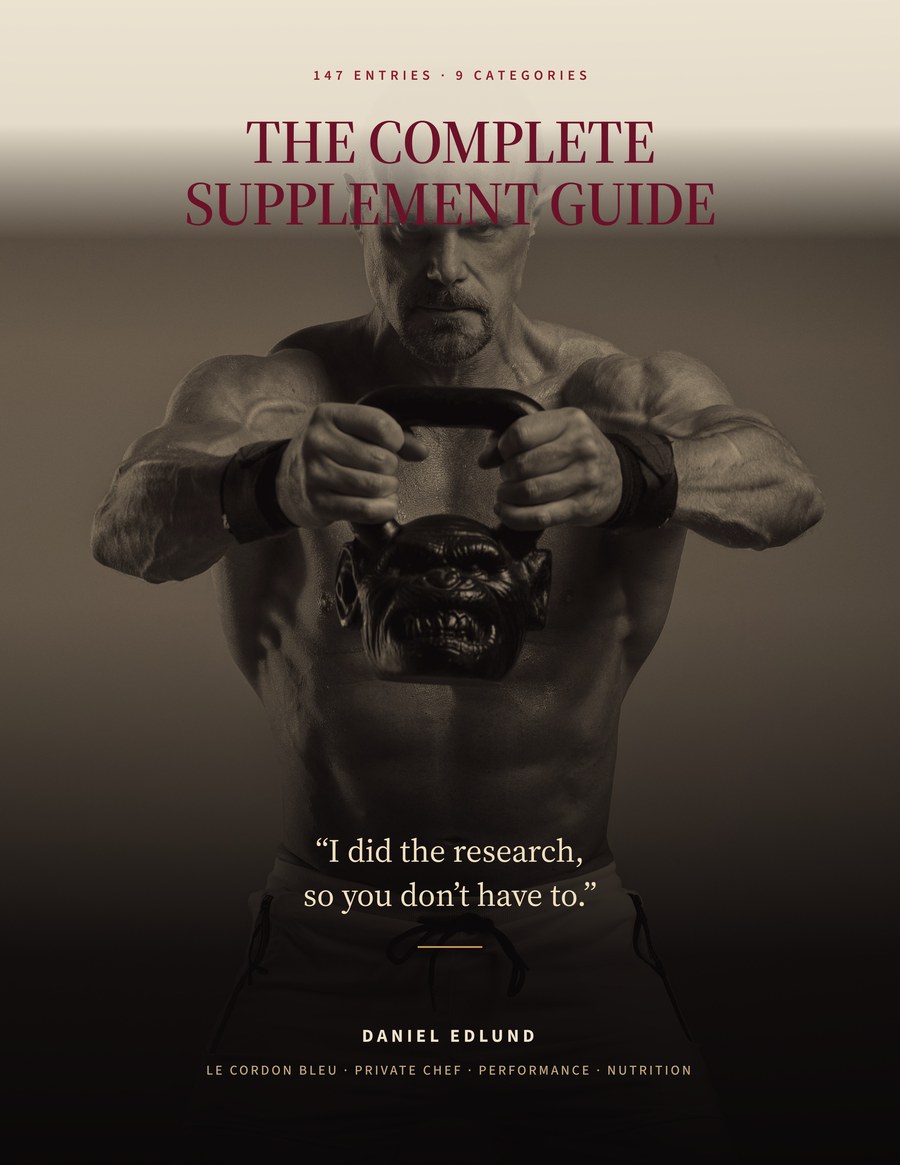
From The Complete Supplement Guide
Which supplements actually have evidence behind them?
15 compounds · top grade · with doses
Fifteen of them, with the dose, the form that works and the mistake most people make. These are drawn from the entries that earned the top grade in my 147-entry guide — the ones where the clinical evidence is consistent enough that I would put my name to a recommendation.
If you would rather see what failed, The Overhyped Ten is published free.
The full guide →
How the grading works
Four grades, and most things do not get the top one
Every entry in the guide is graded against the clinical literature: Strong where the human evidence is consistent and replicated, Moderate where it is real but qualified, Emerging where the direction is promising and the trials are not there yet, and Overhyped where the marketing substantially exceeds what the research supports.
Across 147 entries in nine categories, thirty-three earned Strong. Ten compounds earned Overhyped, and those ten are published in full, free, on this site. The rest sit in between — which is the honest shape of this field, and the reason a guide is worth having.
What follows is fifteen of the Strong entries, condensed to the takeaway. The full entry for each one also covers optimal form, bioavailability, purity red flags, what to stack it with, what to avoid it with, and the food-first alternative where one exists.
Foundations
The four worth getting right before anything else
Vitamin D3 + K2Vitamin D3 behaves more like a steroid hormone than a vitamin. It influences gene expression in virtually every tissue in the body, and most adults living indoors are functionally deficient. Always take D3 with K2 MK-7: K2 directs the calcium D3 mobilizes toward bones and away from arterial walls, and without it, long-term high-dose D3 raises cardiovascular calcification risk. Test your 25-OH-D level. Clinical sufficiency is generally set at 30 ng/mL; the 40 to 60 ng/mL range often cited in performance contexts is an optimization target and a judgment, not a consensus guideline.
MagnesiumInvolved in over 300 enzymatic processes and the critical transport mineral for calcium and potassium. Form selection is essential: glycinate for sleep and stress, malate for energy and performance, taurate for cardiovascular health, threonate to cross the blood-brain barrier. Avoid oxide entirely. Verify elemental magnesium content on the label, not total compound weight. Take glycinate in the evening. One of the highest-return supplements in the guide.
Omega-3 (EPA / DHA)Look at the combined EPA and DHA content on the label, not the total fish oil volume — a 1,000 mg fish oil capsule may contain only 300 mg of actual EPA and DHA. Choose the rTG triglyceride form for best absorption. IFOS certification guarantees purity and rules out rancidity and heavy metals. Take with food. Two to three servings of fatty fish weekly plus a quality supplement is the optimal strategy.
ZincOne of the most important and most overlooked minerals for active adults, particularly men. Deficiency directly suppresses testosterone and immune function. Choose picolinate or bisglycinate, avoid oxide. Take at night with magnesium for a natural recovery and hormonal support stack. If supplementing above 30 mg daily long-term, add 1 to 2 mg copper to maintain the correct ratio.
Training
The five with real performance data
CreatineThe most studied performance supplement in existence, with over 30 years of consistent evidence behind it. Take 3 to 5 g of Creapure monohydrate daily, or 1 to 2 g HCl if you experience bloating or GI discomfort. No loading phase required. Stack with protein and carbohydrates post-workout. Consistent daily use over weeks drives results, not timing. Safe, effective and inexpensive.
CaffeineThe world’s most widely consumed psychoactive compound and one of the most evidence-supported performance tools available. Stack with L-theanine at a 2:1 ratio, theanine to caffeine, for cleaner focus with less anxiety and crash. Cycle off for one to two weeks every six to eight weeks to restore sensitivity. Source your coffee organic and mold-tested. Avoid within 6 to 8 hours of sleep regardless of perceived tolerance.
Beta-AlanineBuffers hydrogen ions inside muscle cells, extending the time before fatigue forces you to slow down. The tingling (paresthesia) after a dose is harmless and fades with consistent use; split doses of 1.6 g two to four times daily to minimize it. Most pre-workout products underdose at 1 to 1.5 g — enough to cause tingling but not enough to build meaningful carnosine. Minimum effective dose is 3.2 g daily.
Citrulline MalateRaises nitric oxide more effectively than supplemental arginine, which absorbs poorly and breaks down before reaching the bloodstream. Use 6 to 8 g citrulline malate or 3 to 4 g pure L-citrulline, 45 to 60 minutes before training. Most pre-workout products include 2 to 3 g, which is below the effective threshold. Check your label. Stacks genuinely and additively with beetroot nitrates.
Beetroot / Dietary NitratesOne of the most evidence-backed whole food performance tools available. It raises nitric oxide through a pathway completely separate from citrulline, making the two genuinely additive when stacked. Take 500 mg standardized nitrate extract or 70 ml concentrated beetroot juice two to three hours before training. Critical note: avoid antibacterial mouthwash on training days — it kills the oral bacteria responsible for converting nitrate to nitric oxide and eliminates the entire performance effect.
Recovery and sleep
The five that work on the other half of training
GlycineThe most abundant amino acid in collagen and one of the most underconsumed in modern diets that favor lean muscle meat over connective tissue cuts. Three grams before bed is one of the most effective and best-tolerated sleep interventions available. Five to ten grams during the day supports collagen synthesis, particularly taken with vitamin C before exercise. Bone broth, gelatin and skin-on animal foods cover glycine well from food.
L-TheanineOne of the cleanest, best-evidenced calming compounds available. It increases alpha brain wave activity, promoting relaxed alertness without sedation. At night, 200 to 400 mg supports sleep onset and quality without next-day grogginess. During the day it pairs exceptionally well with caffeine to smooth out jitteriness. Suntheanine is the verified pharmaceutical-grade form.
MelatoninLess is more here. A 2024 systematic review of 34 trials found zero additional benefit above 2 mg for any sleep outcome, and the 5 to 10 mg doses common in commercial products exceed the body’s natural nocturnal surge by 10 to 30 times with no added benefit and more next-day grogginess. Take 0.5 to 1 mg, 60 to 90 minutes before bed, not right before lying down. Canadian testing found commercial products ranging from 17% to 478% of labeled content, so third-party verified dose accuracy matters enormously. A preliminary 2025 AHA observational study flagged a possible association with heart failure risk in long-term users — not yet peer-reviewed, and correlation rather than causation, but it supports using melatonin intermittently rather than as a permanent nightly habit.
Tart Cherry (Montmorency)One of the most evidence-backed whole food recovery tools available. A 2026 meta-analysis of 19 trials confirmed significant improvement in muscle strength recovery and reduced DOMS following strenuous exercise. It also raises melatonin levels and consistently improves sleep quality. Use the Montmorency variety specifically. Load 60 ml concentrate twice daily for 7 days before a heavy training block or competition.
Collagen PeptidesNot the same as protein powder and should not be treated as one. They are structurally specific: Type I for skin, tendons, ligaments and bones; Type II and UC-II for joint cartilage. Take 10 to 15 g hydrolyzed collagen with 500 mg vitamin C, 30 to 60 minutes before training, for peak collagen synthesis in tendons and ligaments. UC-II at just 40 mg outperformed glucosamine and chondroitin combined in a head-to-head trial for joint pain and function over six months.
Gut
The one with an FDA-authorized health claim
Psyllium HuskOne of the most evidence-backed dietary fibers available, with strong data across bowel regularity, cholesterol reduction, blood glucose management and microbiome feeding — one of the highest return-per-dollar gut health investments in the category. It is also one of the few supplements with an FDA-authorized health claim for cardiovascular risk reduction. Take with a large glass of water immediately: psyllium absorbs water rapidly and can cause choking or esophageal blockage if swallowed without adequate fluid.
The rest of the guide
The Complete Supplement Guide covers 147 entries across nine categories, each graded Strong, Moderate, Emerging or Overhyped against the actual clinical literature — with dosing, optimal form, bioavailability, purity red flags, what to stack it with, what to avoid it with, and the food-first alternative where one exists. 177 pages.
Read the full guide →
Instant download. Thirty-day refund, no questions asked.
Medical disclaimer. Daniel Edlund is not a licensed physician, registered dietitian, or licensed healthcare provider, and is not authorized to practice medicine or to diagnose, treat, cure or prevent any disease or medical condition. This page is provided for general educational and informational purposes only and does not constitute medical advice or a substitute for consultation with a qualified healthcare professional. Dose ranges given here are general figures drawn from publicly available research, not personalized recommendations, and they are not adjusted for your bodyweight, age, medication or health status. If you have an existing health condition, are pregnant or nursing, are scheduled for surgery, or are taking prescription medication, consult your physician before beginning, changing or discontinuing any supplement. Statements regarding dietary supplements have not been evaluated by the Food and Drug Administration.